Amateur
Radio Station W4EKQ
 This where it all happens so to speak. You
talk into a microphone, it goes into a little black box full of
all kinds of electronic parts, then it goes into a big black box
(sometimes) full of the same stuff, then into a special kind of
wire that goes out the window. From there it goes to the
conglomeration of tubes, wires and angles in the picture below.
This where it all happens so to speak. You
talk into a microphone, it goes into a little black box full of
all kinds of electronic parts, then it goes into a big black box
(sometimes) full of the same stuff, then into a special kind of
wire that goes out the window. From there it goes to the
conglomeration of tubes, wires and angles in the picture below.
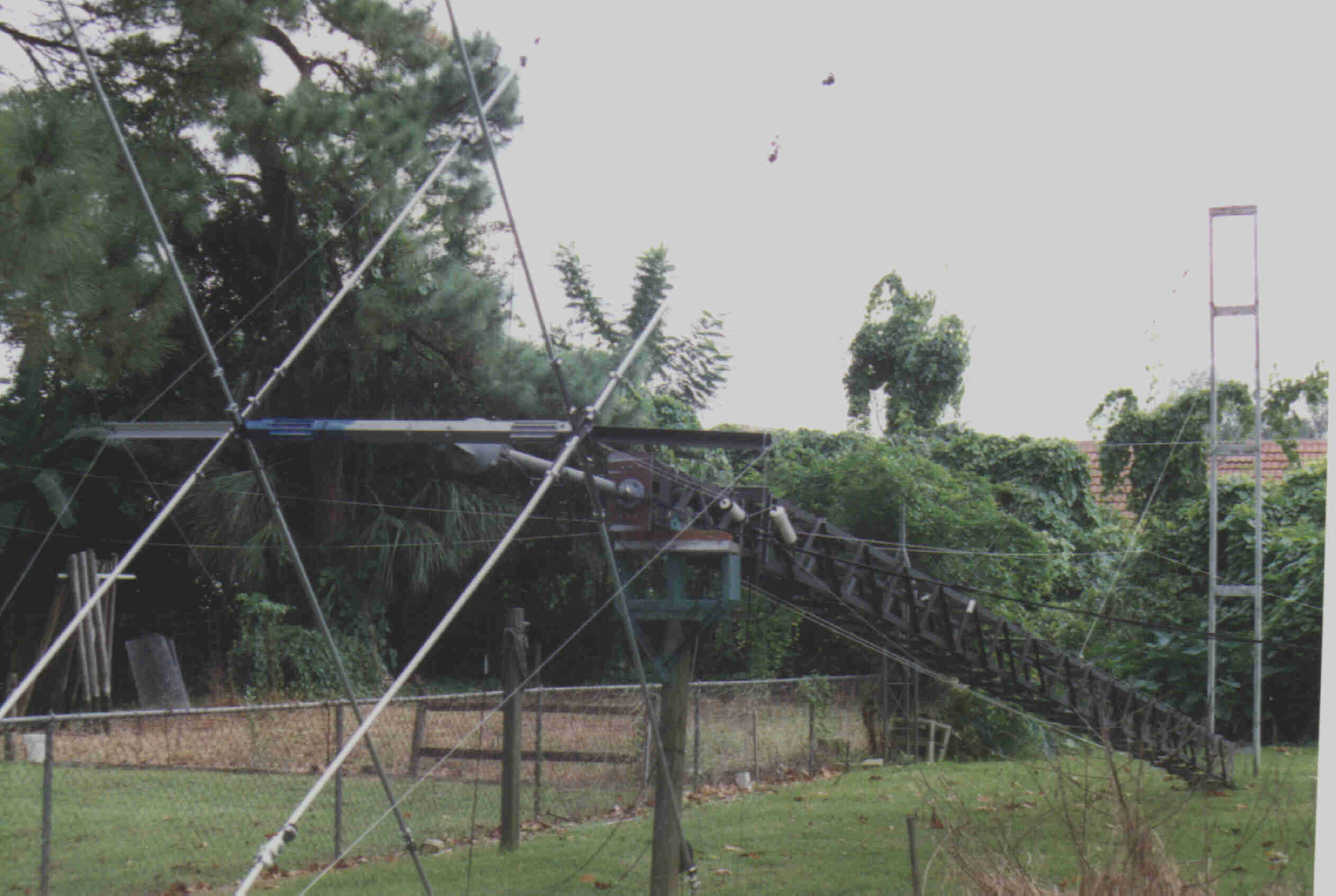
There will be a slight pause while we seek
inspiration.
Break Time
There are more kinds of antennas than there
are Campbell's soups. Beams, verticals, quads, dipoles, long
wire, V's, rhombics and so on. This antenna is called a quad.
There are wires stretched around the tips of the two
"X's" you see to form quadrangles -abbreviated to quad.
The loop that the special wire coming from my window is attached
to is called a "driven element". The other loop is
called a director if it is slightly smaller or a reflector if it
is slightly larger. Takes a bit of doing to get one of these
things just right. The overall length of each loop is pretty
critical, as is the spacing between the loops. So much for the
high tech stuff.
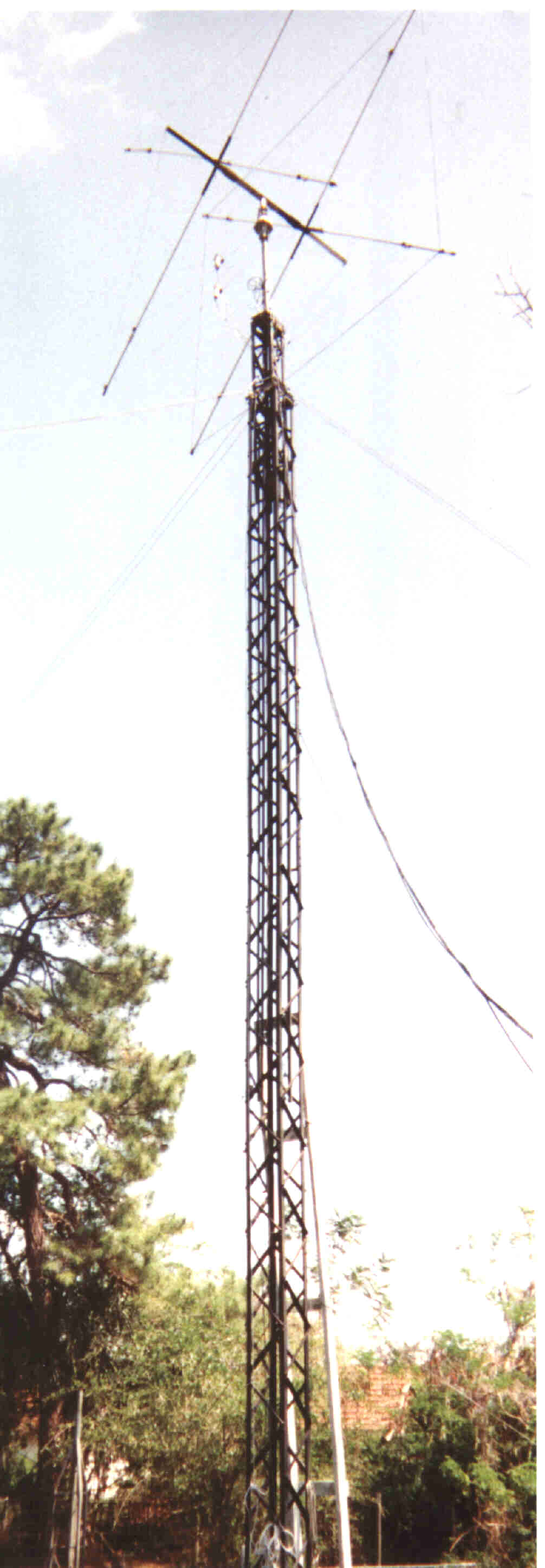
Well, now it is up
again. That big bulb just below the boom is called a rotator and
it lets me point the quad in asny direction I choose. Once it is
pointed where I want I can just listen or try to talk to someone
who might be calling "CQ". "CQ" is a sort of
a general call, and translated it means "Hey, anybody out
there wanna chat?". If I decide I want to talk to him, I
talk into my mike, it goes through the black boxes, into the
special wire, then up to the driven element. From there it
squirts out into the atmosphere in a big lobe. Amateur signals
don't go just straight where you point them - they all go up at
some angle, the amount of the angle determined by the kind of
antenna you are using. They keep going up until they hit the
ionosphere, referred to as the "Heaviside Layer",
bounce down to earth then back up again, back down again and so
on, ad infinitum. If the person I want to talk to is in the area
of one of the earth bounces then chances are we can communicate
if my signal is still strong enough. Each bounce takes a little
out of it. And of course all of this is affected by the magnetic
disturbances on the sun. Strong magnetic storms - nobody talks to
nobody. And then there are days when you can talk to almost
anybody almost anywhere. That's what makes amateur radio
interesting. I get a lot pleasure talking to Australia, New
Zealand, the Isle of Man, Reunion Island (Look THAT one up on the
map!) and dozens of other fascinating places. I've made a lot of
friends and some of them I have even had the pleasure of
visiting. You'll see when the Australia-New Zealand photo album
gets done.
OK,
this ends my little dissertation on amateur radio. Hope you found
it interesting.
Back to main page
e-mail me at
This
page has been visited  times.
 |
| |