The Joy of Wood
There must be thousands of kinds of wood scattered around the world, but we are going to talk about just a few. Here are some that have attracted me because of grain, color, texture, and in a couple of cases, their ease of working.
Aromatic Cedar
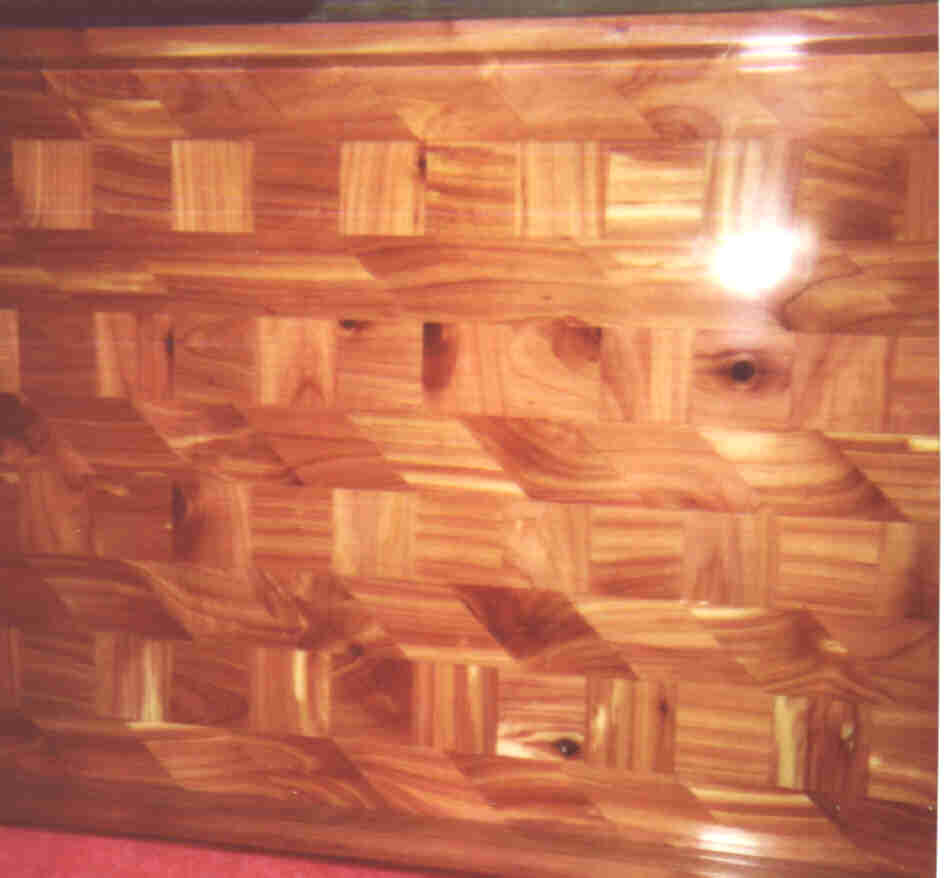
Of all the woods I have worked with, Aromatic Cedar is probably my favorite. On the darker side the wood tones range from pink to almost purple. On the lighter side they range from off-white to a deep cream. Cedar is extremely easy to work with, and will turn, saw, plane, join, glue, sand and route very well. A note of caution about routing - the grain in aromatic cedar is very unpredictable. In a 3-inch wide piece of wood, the grain may be straight on the left side, yet run twenty degrees off the vertical on the right side. If you are routing down with the grain, no problem. However, if you are routing against the grain and are taking too big a bite, the router bit can get under the grain and rip the wood ahead of the router bit. Result - workpiece ruined! If you cannot avoid routing against the grain, then take very small bites with your router, not over 1/16". With such a beautiful grain there is no need to stain. Sand, seal and lacquer - that's all it needs. If you have never worked with aromatic cedar before you will be amazed at the change in grain contrast when you hit it with that first lacquer spray. Sand between every five coats with 320 grit and when you are ready for the final coat(s) hand sand with 400 grit, then three more coats. Allow to cure about four days, under forced air if possible, then wax with a 100% carnauba car wax such as Simoniz or Kit. Don't use spray waxes such as Pledge, silicone waxes or waxes that are colored, such as Turtle Wax. Aromatic Cedar is the perfect choice for hope chests, jewelry boxes, miniature chests, lamps, serving trays and even pens. If you are a pen-maker, do one from aromatic cedar. You'll be glad you did. One other significant point - of all the decorative woods, aromatic cedar is the least expensive. Local price - $2.50 board/ft, sanded both sides. That's not much more than plain old yellow pine!
bocote (bo-KOH-tee)

We're still working on this page.
e-mail me at
| This
page has been visited |